Community-based Participatory with Individuals with Intellectual and Developmental Disabilities
Community-based participatory action research (CBPAR) involves the participation of the community and shared ownership of the entire research process1. Research occurs within the community, not for the community2. CBPAR requires a long-term partnership and commitment to the community, one built with trust and transparency3. This trust and transparency demand accessible research practices supporting members’ needs. While these strategies are like are being utilized and designed for a collective with people with I/DD, these practices would benefit most people engaged in CBPAR. When services or practices center on people with identified needs, it benefits the entire society because the foundation of practice is built on accessibility4.
Reflection: The Spaces We Share
When considering the actual space for our group to meet, there were many factors contributing to our decision. We meet online for our collective meetings. We meet in the evening to prevent conflict with work schedules. We chose an online format for convenience and accessibility. Many of the members of Advocacy for Success do not drive or have their own transportation to get to and from the meetings. Thus, many would have to pay for public transportation or accessible ride share. Online ensures everyone can access the meeting from wherever they are. The collective did want to meet in-person to build relationships and get to know one another. For those meetings, we meet in the community at an agreed upon location. We take time in our community meetings to gather ideas of places to go to and ideal meetings that work for everyone’s schedule.
Consent and Assent
In traditional research studies, consent is one of the first steps in the research process5. This process usually entails outlining the entire research process, expectations, and outcomes. This research practice here is necessary and vital and can involve an on-going and interactive consent process6 7.
Reflection: Consent and Assent
When applying for IRB approval when working with the collective and establishing a research agenda, the IRB determined that this was not research. However, it was important to continue to pursue consent and assent from the members of the collective. I drafted a consent document outlining our work. I offered the choice to use their name and record them in the research process. While this is not required being transparent about what is happening and the potential outcomes is important. I provided a space for their guardian (if they have one) to sign and provide them with the choice to make their guardian aware. Additionally, reminding people of their rights to participate or not in the research process when we meet.
How we run meetings
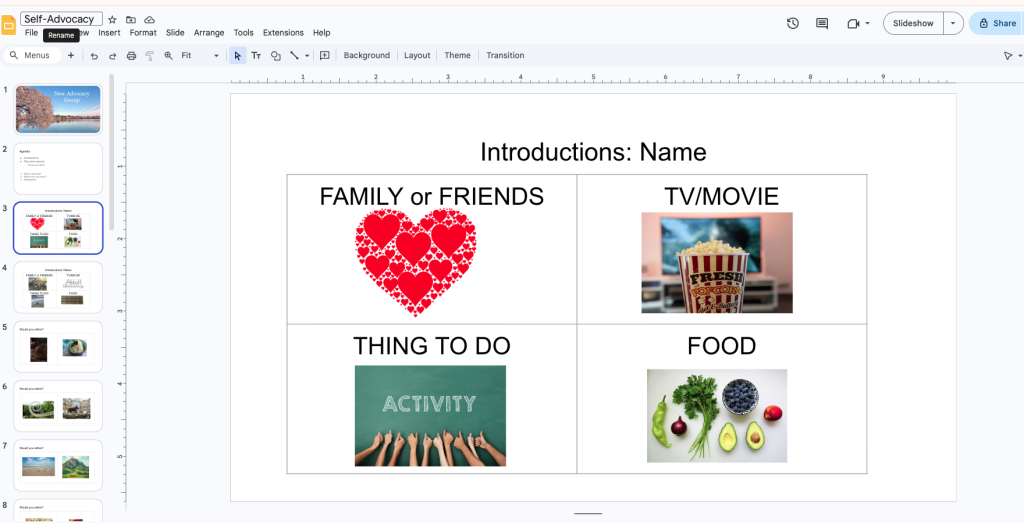
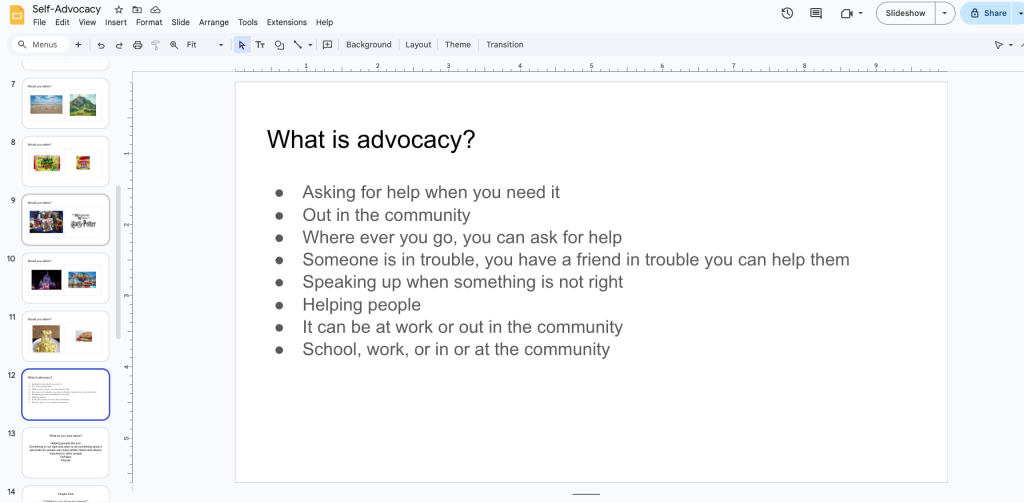
When our collective meets, we start our group with small talk and learn what is new with everyone. After that I have a created a Google slides presentation at each meeting. I share this on Zoom, so that all the members can see what I am displaying and typing. I usually keep the presentation in edit mode so that I can type and track the discussion. This provides a visual representation of what we are talking about as we are discussing items. I can quickly and efficiently add pictures, images, or websites and take notes as we discuss the items on the agenda. When the collective first began, I established the agenda and at the meeting would go over the items and see if they wanted to remove or add any items. When we established the leadership team, they set the agenda for the larger group. The use of Google slides allows me to keep track of our discussions.
I used this format when we created presentations for groups, designed our website, and created our logo. I share my screen and type as they are talking. I gain consent from the group or individual about the design, the images, the font, and the font size.
- Call-Cummings, M., Dazzo, G., & Hauber-Özer, M. (2024). Critical participatory inquiry: An
interdisciplinary guide, Sage. ↩︎ - Freire, P. (1993). Pedagogy of the oppressed. Continuum. ↩︎
- Call-Cummings, M., Dazzo, G., & Hauber-Özer, M. (2024). Critical participatory inquiry: An
interdisciplinary guide, Sage ↩︎ - Cammarota, J., & Fine, M. (2010). Youth participatory action research: A pedagogy for transformational resistance. In Revolutionizing education (pp. 9-20). Routledge. ↩︎
- Creswell, J. W. & Creswell, J. D. (2018). Research design: Qualitative, quantitative, and mixed- methods approaches. Sage. ↩︎
- Call-Cummings, M., Dazzo, G., & Hauber-Özer, M. (2024). Critical participatory inquiry: An
interdisciplinary guide, Sage. ↩︎ - Tanabe, M., Pearce, E., & Krause, S. K. (2018). “Nothing about us, without us”: Conducting participatory action research among and with persons with disabilities in humanitarian settings. Action Research, 16(3), 280-298. ↩︎