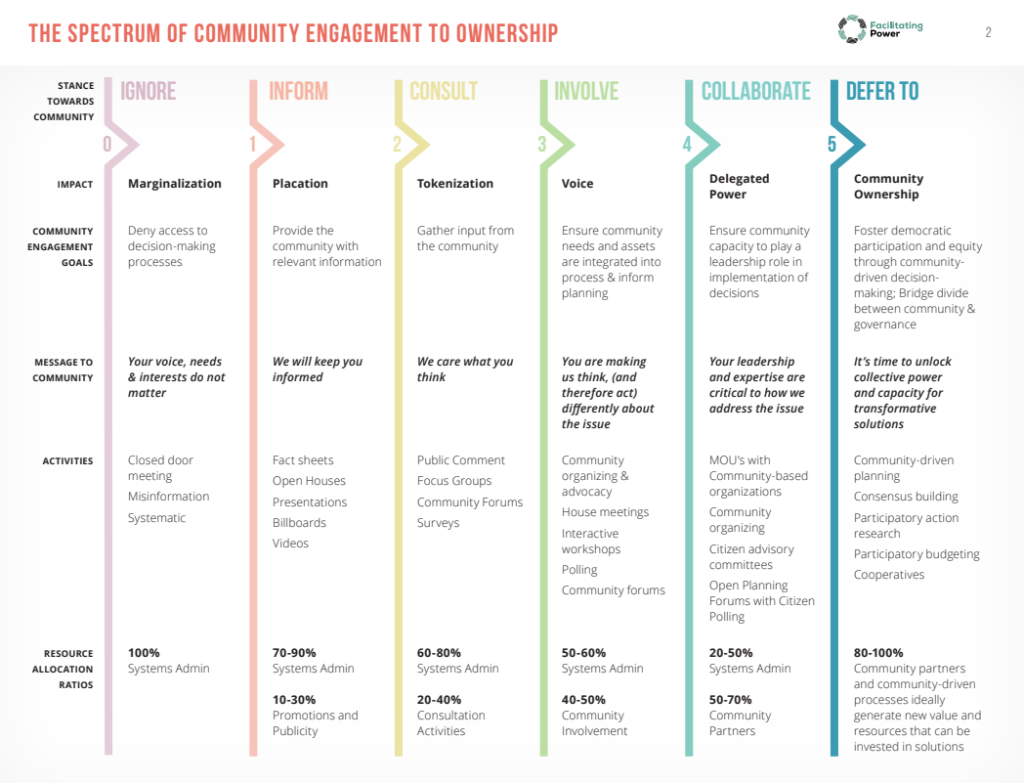
Literature1 2outlined the process to establish a community advisory board or collective. In their participatory action research, community leaders and university researchers gathered together at a regular time. Both community leaders and university researchers committed themselves to improving the experiences of families in their community, then committed to the mission of the collective, and building trusted relationships among the group. This process takes time which demands an ongoing reflexive process. University researchers critically examined their positionality, roles, actions, and perspectives. As a result, there is constant interrogation and scrutiny of power dynamics existing between all the members of the collective. The work that collectives do include establishing norms, expectations, branding, and identifying a research agenda. Researching together and utilizing research to drive action. Doberneck and Dann3 used an abacus as a visual to represent how researchers in partnership with the community can shift based on the needs, skills, talents, and capacity of the community. Similarly, The Spectrum of Community Engagement to Ownership4, which describes how a community cultivates their capacity to create change within systems. Community engagement can have a variety of stages ranging from simply informing the community, consulting with the community, involved the community into the process, collaborating with the community in decision-making processes, and then deferring to the community in a democratic process. Knowing when to move along the continuum or move the bead across the abacus involves reflexiveness, trust, and transparency.
Gonzalez’s (2019) Spectrum of Community Engagement to Ownership
For the full toolkit: https://movementstrategy.org/wp-content/uploads/2021/08/The-Spectrum-of-Community-Engagement-to-Ownership.pdf
Reflection on Establishing the Advocacy for Success Collective
Establishing a collective first began with approaching an advocacy organization, The Arc of Northern Virginia. The Arc of Northern Virginia’s (2026) mission to advance the rights and participation in society aligns with the idea I had as a researcher to establish this collective. Through my professional work as a public educator, this chapter of the Arc and the members of the Arc there was an estbalished and trusted relationship. In January of 2025 I approached with leaders within The Arc of Northern Virginia to discuss my goal and this idea of a collective. I began volunteering at their monthly meetings. Then I advertised with members of their People First group. We had our first meeting in March 2025. At that time, we had four people who consistently attended monthly meetings. Our collective established our group name, Advocacy for Success, developed a logo, and began to develop a website for our group. We established group norms that are frequently revisited. One of the important foundations of this group was to meet socially outside of virtual meetings. We meet frequently (i.e., every two months) in the community to build relationships with social events. Within about seven months of establishing Advocacy for Success, we approached the Arc of Northern Virginia about presenting at their People First meetings. Each of the members of the collective presented self-advocacy and tips to advance self-advocacy and what self-advocacy looks like in the areas of work, friendships, assistive technology, and transportation.
After the presentation, people within the community asked me to be a part of the group through our online form and in conversation. I would share the meeting information and a couple of people would attend and never attend future meetings. The collective wanted to grow the group, and I reflected on the need to preserve the relationship between the original members of the collective. As we approached the one-year anniversary of Advocacy for Success, I was in consultation with Dr. Vesely, who has extensive community-based research experience. We discussed this tension between growing the group, preserving the collective, and the on-going self-reflection of my role within the collective. As the person bringing the research perspective to the collective, I am keenly aware of the power I hold. For two of the participants, I am their former teacher, and in many ways, I am an outsider to the collective. At this moment I am a non-disabled person, and I am older than the collective. Throughout the establishment of Advocacy of Success to present, I am constantly interrogating my role. Am I driving this too much? Is the collective acquiescing to me? Am I making too many decisions? As I reflected on my role within the group, Dr. Vesely validated that this scrutiny was appropriate and necessary, and encouraged me to bring my concerns to the collective and together the collective would discern the next steps. Dr. Vesely acknowledged that the four original members demonstrated committment and leadership, and there is a need to harness this among the collective and to be intentional about the leadership guiding the research. I reflected on this and thought about how I could address the collective as interest built outside of the original group.
At the February 2026 meeting, the people who attended the meeting were the original four members of the collective. I took this opportunity to bring this concern to the attention of the original members. I recognized their dedication to Advocacy for Success, and how they have naturally become leaders. I talked to them about becoming a leadership team that would guide the work. At first, I referred to them as the executive board. They questioned the term “executive board” and asked if we could call it something different. We came up with the name leadership team. I asked if any of them served on a leadership committee. One of the members said no one has ever asked her to be a leader before. We discussed how I was running the group, setting the agenda, and doing logistical planning, and they were also very capable of doing these things. They agreed and asked how they could be leaders. We discussed how we would meet the week before the meeting. They would set the agenda for the following week, create the activities together, and discuss research or other items that we would like to pursue to tackle. All four of the members agreed to make this commitment. We discussed the differences between being a member of Advocacy for Success and being the leader. I spoke to them about how people wanted to join our group and how we could invite more people to be a part of it. The leadership team started to invite people who they knew. The leadership team meeting would give time to discuss and make decisions. The Advocacy for Success group meetings would be for individuals who want to discuss self-advocacy and build relationships and support the work determined by the leadership team.
This decision to shift the collective to the leadership team had profound effects. First, I instantly felt that the power dynamic shifted to a more collective process. I felt a sense of relief. I was making small decisions about inviting people or not inviting people based on their participation. This was a decision that I brought to the group, and they decided to offer invitations to people. The leadership team identified the agenda and talked through their thinking and decisions. The power of decision making shifted. The abacus beads of decision making moved away from the researcher to the collective (Doberneck & Dann, 2019). Considering “The Spectrum of Community Engagement to Ownership”, our collective moved across from collaborating to deferring to the community (Gonzalez, 2019). When I reflect on this shift, I think about the time and trust built over the past year in establishing the collective. It takes time spent with the collective to build trust in me and in our collective together. When I brought them the idea of the research, we were informed by our on-going conversations among the collective. The collective was concerned about doing research alone. My response to them was that we would complete research in the way we have worked throughout this time; we would do it together. Their response was, “then, we can do that”. Establishing a collective is more than group work. It takes time, on-going scrutiny, commitment, and building trust through relational work. For this collective, I see how ableism impacts the expectations of the members as they have had limited leadership experiences or expressed concern about completing the work on their own. The members of the collective trust me to make the process accessible, and I am trusting them for feedback, and together we make decisions to advance our objectives to discover about the experience self-advocacy and how society can better listen.
- Letiecq, B., & Schmalzbauer, L. (2012). Community-based participatory research with Mexican
migrants in a new rural destination: A good fit? Action Research Journal, 10 (3), 244-
DOI: 10.1177/1476750312443571 ↩︎ - Vesely, C.K., Letiecq, B.L. et al., Goodman, R.D., & DeMulder, E. (2023). Amigas de la Comunidad: A Critical Case Study of Community-Based Participatory Research (CBPR) with Central American Immigrant Mothers. In M. Call Cummings G. Dazzo, G., & M. Hauber-Özer, M., Critical Participatory Inquiry: An Interdisciplinary Introduction and Guide. Newbury Park, CA: SAGE Press. ↩︎
- Doberneck, D. M., & Dann, S. L. (2019). The degree of collaboration abacus tool. Journal of Higher Education Outreach and Engagement, 23(2), 93-107. ↩︎
- González, R. (2021). The spectrum of community engagement. Facilitating Power.
https://movementstrategy.org/wp-content/uploads/2021/08/The-Spectrum-of-Community-Engagement-to-Ownership.pdf
↩︎