Reflexivity before the collective starts
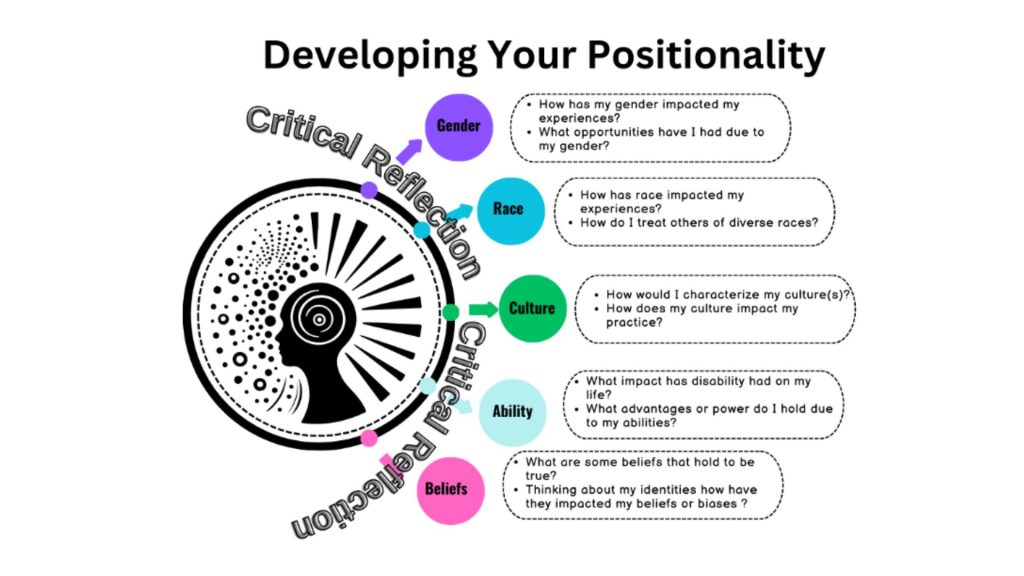
Kimberle Crenshaw1 established that people hold many identities, which intersect with one another illuminating the unique experiences of people. How a person experiences based on their race, class, gender, sex, ability, sexual orientation, and other constructs of identity shapes how they engage with the world and how the world receives them as well. Understanding one’s own position in the world and how that position exists in relation to others begins to describe positionality. It is vital and necessary for researchers to engage in reflexive work to identify the identities researchers hold and the power they hold within these identities by mapping out their identities.2
To begin this process, I developed and used this figure to identify and reflect on my own identity. When I started to articulate my identity, I thought about the terms. I am a cisgendered, middle-age, heterosexual, white woman. These terms positioned me within the world but did not capture my worldviews, experiences, and beliefs. I began to think more deeply about my experiences.
Read My Own Positionality Statement
My Italian American family ran their own business for 47 years. All the children, including myself, worked at our family auto repair and gas station called, “the shop”. My father had a tradition of training young employees. He led you to where the sidewalk met the busy road and said, “You see these cars coming and going. They have one thing in common, they all need gas. You will see all kinds of people come into this shop. People who drive nice cars and others with clunkers. No matter who they are or what they drive, you will treat them with respect and dignity because that is who we are.” My family was incredibly proud of the service to our community because we got people to where they were going. Every person in my family contributed. My grandmother provided a three-course lunch out of her car trunk to her sons and any delivery person passing by. My mother and aunt provided unwavering emotional, physical, and spiritual support to all of us. My family believed in collectivism built on the belief that love is action. The men who were the driving forces in this business also had disabilities. My family created a business and a legacy with their determination and diverse abilities.
I became a special educator because I struggled in school. When a high school teacher created an opportunity for me to demonstrate my knowledge in unconventional ways, I finally saw myself as a capable learner. I believe education discovers talents of students, cultivates them, and then creates spaces for the community to celebrate them. Special education goes beyond making concepts accessible or maintaining compliance, special education develops the vision of the child. Education fosters independence and greater involvement in the community. Education is emancipatory.
Being a parent affirmed my educational philosophy and provided an emic perspective when working with families as an educator. My children have been diagnosed with learning disabilities, anxiety, and/or attentional needs. I know the depth of the love a parent has for their children. Through advocating for my own children, I witnessed how vital resources can advance the development of a child. I believe that in my role as an educator, I have a responsibility to support other families in gaining access to needed resources. This love and passion for my own children is a part of my practice and reflexivity when working with students and families. These emotions and experiences also call for critical reflection on the many barriers which exist for students and families (D’Cruz et al., 2007).
As a researcher I seek to better understand human experience as it relates to special education and disability services. Whether welcoming customers at the shop or students into my classroom, I have seen the value of diverse accounts of human experience. Every role within a community is important, and people of all abilities are vital to its ecosystem. My ontological belief is that there are multiple truths, and these truths can evolve. Qualitative research provides insight into lived experiences and how people engage with the world (Ravitch & Carl, 2021). The epistemological approaches I would implement are social constructivism and critical theories. Social constructivism understands how people make meaning through their experiences, cultures, all forms of language, and action (Neubert, 2009). Social constructivism helps to understand lived experiences, and as knowledge is shared it is equally important to create change. A framework to enact change is through critical participatory action research (CPAR). CPAR researchers share the ownership of the research with the community from design of the research through to social action (Fine et al., 2021). This shared responsibility with the community is important when considering I identify as a part of the dominant culture as a white, cis-gender, heterosexual and able-bodied woman. My interest in utilizing CPAR is built on the foundation that knowledge is to be shared and love is action. The collective approach to understand experiences, identify problems, and work together to break down barriers and create accessible new ones is both familiar in my life and a necessity for those in my community.
References
D’ Cruz, H., Gillingham, P., & Melendez, S. (2007). Reflexivity, its meanings and relevance for social work: A critical review of the literature. British Journal of Social Work, 37, 73- 90.
Fine, Torre, M. E., Oswald, A. G., & Avory, S. (2021). Critical Participatory Action Research: Methods and praxis for intersectional knowledge production. Journal of Counseling Psychology, 68(3), 344–356. https://doi.org/10.1037/cou0000445
Neubert, S. (2009). Pragmatism, constructivism, and the theory of culture. In Hickman, L., Neubert, S., & Reich, K. (2009). John Dewey Between Pragmatism and Constructivism (1st. ed.) Fordham Univ. Press. https://doi.org/10.1515/9780823237807
Ravitch, S, & Carl., N. M. (2021). Qualitative research: Bridging the conceptual, theoretical, and methodological. (2nd ed.). Sage.
Positionality Before the Research Process Starts
Critical Questions to Ask Before the Research Process by Christina EagleCritical Reflection Before My Research Journey
Early in my doctoral journey, community-based participatory action research (CBPAR) intrigued me. I started this doctoral journey because I witnessed the structural inequities my students faced and how limited the opportunities existed in the adult world. I believed in the capabilities of my students to advocate for change. As the planning for my dissertation started to take shape, I considered CBPAR as an approach and methodology. The first question I scrutinized over was the level of commitment I have to build this collective and sustain this relationship. Was I going to build something and abandon it? I am a mother of teenagers, a wife, an educator, and full-time doctoral student. Time is limited. Doctoral work is time away from the people you love. This work of engaging in an ongoing relationship with the community, aligned with my beliefs, values, passions, and heart. I decided that this was how I wanted to spend my time, energy, and resources. I decided that I would establish a collective of adults with I/DD with a focus on self-advocacy. When I communicated the idea of developing a collective of people with I/DD to my advisor, she asked me to explore the ways in which my position as an able-bodied, middle-aged educator would have power over the individuals with I/DD who comprised this collective.
How do I embody and use power? At first the question made me laugh, I am a female educator in America, not the most powerful or valorized role at this moment in history. Then I really started to think about my position and power within the education system. I had power over students, and then I reflected on how differently I would need to approach this researcher’s role within a collective. My job was not to make executive decisions, rather collective ones. Within a classroom, I can scaffold students’ thinking to the “right” answer, I scrutinized over the ways I would need to approach that educator approach. The education systems functions in an ableist manner, focusing on deficits of students and “fixing” those deficits. I also thought about my perspective as a parent, and how that has influenced me. I am a caretaker, and at times I act paternally, knowing what is best for students. I started to identify paternalistic thinking and behaviors. I started to reflect on the ways in which I can stifle self-advocacy in the guise of knowing better. This reflection began to change me as an educator and parent. Recognizing and honoring the autonomy and actualization of another person and giving them the opportunity to make decisions, feel the consequences (both positive and negative), and supporting them through the process is an intentional process, especially when taught to minimize the liabilities and scaffold to success. Being aware of my own ableism and paternalism is on-going process. I humbly approach this research process, knowing that there may be times I overstep, and I am here to learn from the lead of the collective members.
Reflexivity During the Research Process
Reflexivity is an on-going transformative process in which researchers engage in learning and unlearning, identifying and dismantling assumptions, and affirming and challenging beliefs3. Reflexivity demands an evaluation of personal beliefs, assumptions, and learned behaviors and opens oneself to learning beyond what they already know. As researchers there are different kinds and types of reflexivity, which require researchers to think about theirs beliefs and actions in relation to the community and research. Epistemological reflexivity4 considers the beliefs researchers have to their research. This aligns with the circle of research5 that epistemology, axiology, ontology, and methodology are woven together. Researchers may need to unlearn behaviors or beliefs to uphold foundational commitments to the community and to research.
When the collective began, we met virtually to ease some of the constraints of transportation and finding a location. Virtual meetings made the most sense. When we have meetings, I usually share the screen and agree to the agenda, discuss, and enjoy each other’s company. At first, I felt uneasy because it felt very teacher behavior, going through the slides and talking and asking for participation. I was very unsettled with my role as I felt like I was the leader and the power dynamics I wanted to avoid were being perpetuated. Within our first meeting, I had mentioned that I wanted them to lead the meetings too. One of the members of the collective laughed,“you want us to lead?!” and I responded by affirming their expertise in being themselves. I thought about how all of us are unlearning. It is unrealistic to think that in one meeting or even two we would establish a community outside of societal norms. It takes intention and time to unlearn what we know and become something that challenges the norm.
After about a year of the collective existing, I had another example of ongoing reflexivity. As a special educator, I must employ evidence-based practices under the Individuals with Disabilities Education Act (IDEA). Within my career, parents and students have within their personal lives engaged in strategies which are outside of the evidence-based practices. For example, past students engaged in communication methods such as rapid prompting method which are not considered evidence-based practices within the IDEA definition. As a result, the school divisions I have worked for did not allow such methods to be used within the school system. As a result, I have assumptions about such methods formed in part from my perspective as an educator within the school system. As the collective established a member of the disability community asked to join our group. He is a nonspeaking autistic man, and uses a communication partner. From this request, anxiety emerged for me because of my experience within the school system. I recognized these feelings, and I thought about my epistemological commitments. The purpose of this group is to advance self-advocacy for people with ID/D. Is my role as a researcher within a collective to gatekeep? I believe that all people have voices and those voices should be treated with dignity and respect. What if I do not agree with how they communicate? Is that for me to judge? I thought about the impact of the educational system on me, how it has shaped me, and considered if I wanted these institutional beliefs to impact my actions. Ultimately, people should be able to communicate however they want.
- Crenshaw, K. (1991). Mapping the Margins: Intersectionality, identity politics, and violence
against women of color. Stanford Law Review, 43(6), 1241–1299. https://doi.org/10.2307/1229039 ↩︎ - Jacobson, D., & Mustafa, N. (2019). Social Identity Map: A Reflexivity Tool for Practicing Explicit Positionality in Critical Qualitative Research. International Journal of Qualitative Methods, 18. ↩︎
- Palaganas, E. C., Sanchez, M. C., Molintas, M. P., & Caricativo, R. D. (2017). Reflexivity in Qualitative
Research: A Journey of Learning. The Qualitative Report, 22(2), 426-438. https://doi.org/10.46743/
2160-3715/2017.2552 ↩︎ - Palaganas, E. C., Sanchez, M. C., Molintas, M. P., & Caricativo, R. D. (2017). Reflexivity in Qualitative
Research: A Journey of Learning. The Qualitative Report, 22(2), 426-438. https://doi.org/10.46743/
2160-3715/2017.2552 ↩︎ - Wilson, S. (2008). Research is ceremony: Indigenous research methods. Fernwood Publishing.
↩︎